We are not Nothing
Despite fatalistic reductions, currents of democracy remain alive in India

This is the second part of commentary on the recent student protests in India. For a more skeptical account, read the first part.
Dust has settled at Jantar Mantar in Delhi, and the protest site is being cleared. Congregators who had come from as far as Bihar and Tamil Nadu are on their way home, carrying a renewed sense of optimism. It may leave a lot to hope for, but the protests have achieved their earliest and most concrete demand: the resignation of the Education Minister, Dharmendra Pradhan.
It naturally took longer to oust Pradhan. He is a prominent leader from the fecund front for the BJP that is the state of Odisha. As the movement reached fever pitch, Pradhan even shared a photo of a meeting with fifteen fellow BJP MPs from Odisha. That was his show of strength to an audience, surely the Prime Minister being one of them. Among cabinet ministers, Pradhan was also not insignificant. The significance that mattered to the protesters was that Pradhan too was once a student leader.
Even in relinquishing office, Pradhan’s resignation, written in Hindi, anchors the reader in the government’s preferred interpretive universe. He is relentlessly drawing us away from the fact of his resignation, and gently redirecting us to a larger drama playing out, that the nation and public order is his priority, and the future of youth too. He blames anti-national forces for wanting to exploit the situation. His intention appears to taint the opposition that has leveraged the issue well, and to draw into the larger conspiracy theories that youth protests among India’s neighbours Bangladesh, Nepal and Sri Lanka had a mysterious orchestration to them. These remain feeble narratives, as the government did not have enough time and was not quite nimble about narratives. Indian media houses tried their hardest, but protestors were equipped in anticipation. Since the real battleground was social media, the issue seemed too wide-breadth and fertile for more agreeability and recruitment. The narrative battle seemed like theirs to lose.
One needs to reckon with the size of this achievement. While many appreciate the weight of this political moment, people from across the aisle are interested in minimizing its significance for varying reasons. The prominence of what has transpired in the last few days may diminish over time as we evaluate its consequences (remember India Against Corruption?) but we must weigh it before consigning it to oblivion. In my earlier, more skeptical account, I offered that our hopes and meaning-making may be too generous for a movement that congregated so quickly. I also promised to stay Bayesian in that earlier account, even if victories are achieved. Now I engage with newer priors, the ones this week alone provided.
Frame Extension
Analyzing the protests, some political scientists say the BJP is more vulnerable to issue-based mobilization than ideology-based mobilization. Protests over governance failures, unemployment, exam irregularities, were unlikely to be dismissed or wished away, especially with two-thirds of India’s unemployed youth holding a degree. Movements built around a minister’s resignation can extract concessions without the government abandoning its larger project. Movements that go after foundational questions instead, like anti-CAA-NRC’s challenge to citizenship and secularism, had made compromise far more expensive, which is part of why that movement got fewer wins.
The farmers’ movement in these kinds of analyses has also been talked about as an example of the government conceding defeat on an issue, and not an ideology. Facing a year of sustained protest against three new farm laws, the Modi government eventually repealed all three in November 2021, a rare full reversal, and not a partial concession which we usually expect of the regime. Was the farmer movement simply issue-based as opposed to ideology-based? After all, what had started as a fight over the laws had turned over time into a contest over competing visions of the Indian state, market, and democracy. It had also revived to moderate success an agrarian political tradition in western Uttar Pradesh (a vastly relevant constituency for both the movement and the overall Indian electorate) that had histories of being built on cross-community peasant solidarity. Hoping to invoke Former Prime Minister Charan Singh’s old vision of the MAJGAR coalition (Muslims, Ahirs, Jats, Gujars, and Rajputs), movement leader Rakesh Tikait visibly dropped the communal posture he’d carried since the 2013 Muzaffarnagar riots. He had adopted an explicit language of Hindu-Muslim unity. The Muzaffarnagar mahapanchayats were an attempt to rebuild an agrarian identity strong enough to override contemporary communal polarization, imperfect and tactical, but real.
But also, it is easier to assess CAA-NRC as an unsuccessful ideological assertion because the anti-CAA-NRC protests got cut off by COVID, an exogenous shock that cleared the protest sites and changed what was politically possible overnight. It’s hard to know how far that movement would have gotten without the pandemic ending it early. Timing, state capacity, coalition-building, and sheer contingency matter as much as ideological positioning.
All of these pushbacks give CJP a more charitable reading than I first offered it. I’ve faulted CJP, like others, for dodging ideological confrontation and dragging its feet on a grand strategy to build on. This is characteristic of big-tent movements: frame extension, the deliberate broadening of a movement’s interpretive frame to pull in people who don’t share all its commitments yet. Big-tent movements tend to absorb support and swell first. They don’t ask for full agreement up front, so they recruit around whatever grievances overlap and build the wider identity as they go, an approach Abhijeet Dipke, CJP’s founder, has attempted well.
CJP has stayed publicly committed to constitutional democracy and secularism though some deer-in-the-headlights moment unnerved many. Tact often makes us do so many incoherent things, and incoherence, once it starts to be associated with a movement, will weaken it. The involvement of Sonam Wangchuk and his non-partisan politics had started to become a burden for CJP. Not surprising that his faction now represents a splinter, dissociating from the opposition’s novel involvement in the protests. Speaking on the march at Parliament where opposition leader Rahul Gandhi got involved, Gitanjali Angmo, who acted as her husband’s spokesperson in the days leading up to his breaking of the fast, called the move insincere.
CJP’s original slogan on Twitter read “Secular – Socialist – Democratic – Lazy,” the preamble to the Indian Constitution with “Lazy” bolted on as the punchline. Dipke, who built the party’s website and manifesto with the help of AI tools in a few hours, has been explicit that CJP checks “no religion, caste, or gender” at the door. Ambedkar, Bhagat Singh and Gandhi remain models in his ideological assertions. Addressing joyous protestors after Pradhan’s resignation, Dipke calls to consideration the need for the country to move beyond and above “Hindu-Muslim politics”. The crowd gives a resounding roar of affirmation. Dipke then gets interrupted by his peers taking a selfie and stops and smiles. Speaking into the mic again, he goes on to repeat his point:
“Hindu Muslim politics….”
His supporters cheer “nahi chalegi, nahi chalegi” (won’t be tolerated, won’t be tolerated)
Louder, he says, “enough to respond to the ahankar (arrogance) of the government ruling for over 12 years.”
Hyperpolitics
India is a collection of countless individual dramas unfolding simultaneously. Rarely do patterns become so consuming that the entire nation gives out a resounding sound. In the hyperpolitics epoch, perhaps these sounds appear with greater frequency on platforms like Instagram.
The intellectual tradition of hyperpolitics holds that in a media environment saturated by constant, competing claims on public attention, politics stops resolving into discrete events and becomes an undifferentiated field of perpetual contestation. In a hyperpolitics epoch, meaning is not derived from outcomes so much as manufactured continuously, in real time, by whoever is fastest.
CJP and many supporters were uttering from the start that the resignation of Pradhan, then seeming unlikely, was much more than a diminutive concession. They asserted that it shall still be a huge symbolic win. We can also be more charitable to this view now, assuming that we are already in the era of hyperpolitics, and within these bounded possibilities, CJP's victory acts as a successful act of meaning-making. In a time where politics rarely resolves into anything significant, any resolution may indeed be the conceivable achievement. The government is already playing into hyperpolitics, for instance, the cabinet meeting seemed to have only perception-based strategies rather than policy-based, all pointers urging ministers to do better dissemination through Instagram. The fertile ground of influence was correctly identified, the Prime Minister also notably appearing on Instagram for announcements.
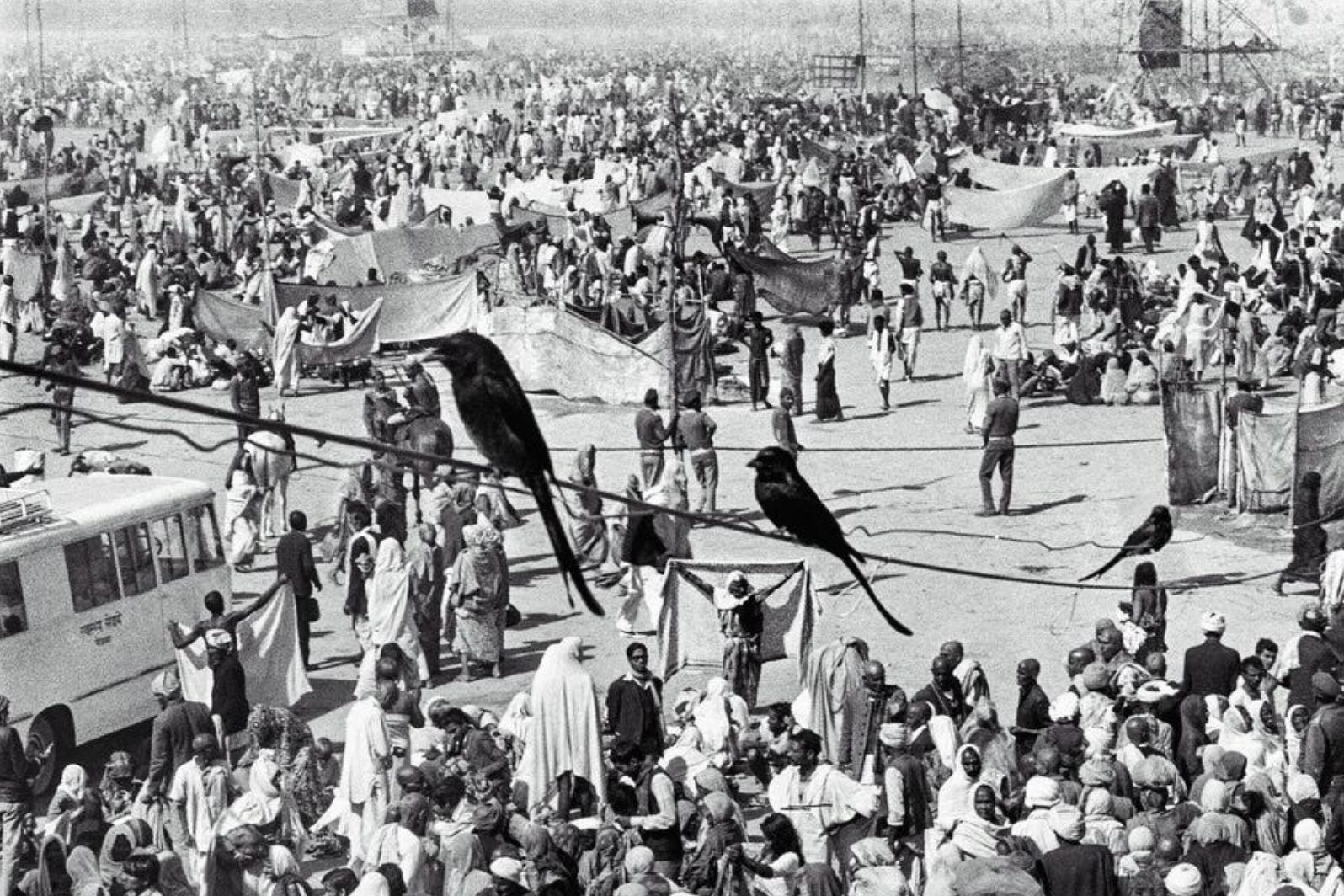
Since we are in a markedly new political era, one tends to look into the past to think about a probable future. The veteran photojournalist Raghu Rai's passing in April had triggered a deeper interest in browsing his work from across people's movements in history. When I was browsing through the galleries teeming with the realist pictures of India and its unusually engaged electorate, I found his camera had turned toward both the Emergency, where he embedded himself with the opposition leader Jayaprakash Narayan, and decades later with Anna Hazare's crowds too; his ever-present gaze over moments of collective action.
One particular picture was of interest, and I had secretly hoped I would be able to use it to some sort of affirmation in the survivability of India's democracy. In this photograph from the Kumbh in Allahabad, two black drongos sit on a power line, watching a vast, transient human congregation below. Drongos are famous for attacking birds many times their own size, through a defensive strategy called mobbing. The drongo dives, again and again, whooshing across its intruder until it is overwhelmed and simply decides the airspace isn't worth it. The predator remains a predator; it will test that airspace again another time. In Hindi, drongos have earned themselves the colloquial name of kotwal, a name that is synonymous with watchmen and vigilance-keepers, and, ironically, police chiefs. It is absurd to extend a drongo’s significance to the literal police forces in the current political moment. Weaker birds, bulbuls, doves, mynahs, nest close to drongos because they can’t fight predators. Proximity to something so fierce acts as a shelter. The drongo seems unbothered by who exactly it’s protecting or why they’ve come.
The anonymous multitude at Jantar Mantar was not a single organism but thousands of individuals with their own decisions, affiliations, and internal negotiations. Some said they were supporters of the Prime Minister and might continue to vote for him, separating the education ministry’s failures from his leadership; others arrived carrying grievances that had nothing to do with leaked exams. They folded into the crowd because the crowd provided them an outlet. What CJP extracted from the state was certainly proportional to its size. It was proportional to its persistence, and to how many separate people decided, on their own terms and for their own reasons. It becomes easy to imagine that the CJP was a formidable, fierce drongo, sheltering many in its nest.
Skeptics including myself have from outset questioned the limited playground that CJP is playing on, we were exasperated with the intention to be a political party and lethargy over the more durable project of organizing. Anton Jäger, the central figure in the study of hyperpolitics thanks to his 2026 book of the same name, is a historian of political thought at Oxford. His account of the last decade is that engagement has surged everywhere while the old machinery like parties, unions, durable civic organizations, have been hollowed out from underneath. What fills the gap is intense but fleeting. Outrage peaks and clears within a news cycle. People show up, feel something at full volume, and disperse, having built weaker political structures. The leaders inside these weaker conditions also behave differently. Where twentieth-century mass politics ran through institutions strong enough to outlast figures, Jäger’s hyperpolitics runs increasingly through the figure directly, a charismatic shortcut standing in for the party infrastructure. Recent elections in West Bengal, where the ruthless Trinamool Congress led by behemoth Mamata Banerjee was defeated, saw similar analysis emerge. Where was the party cadre that so defined the politics of the state?
Lack of organization hereon will continue to be a challenge depending on how CJP evolves, maybe the baton will pass to the opposition, then we must too pass the baton of our analysis to the wider oppositional tent.
Democratic Imaginaries
Youth grievances, on the account of them being the agents of their own future, were always a potent reason to weigh their demands in a somewhat special way. I had said a few things about the overstated prominence of the youth framing, but have to concede that this would not be true without some signature Gen Z swings of humour. It is humour exactly that transcends geographical and political boundaries, that keeps a movement from calcifying into solemn and boring.
The Instagram video I admired most in the aftermath of Pradhan's resignation was made by the psychologist Manish Verma. Verma, who also calls himself a "de-influencer" with his typical Gen Z sartorial choices, walks up to a Delhi police constable outside the Jantar Mantar protest site to record their reaction right as the resignation is announced.
Aap log khush ho? (Are you all happy?)
The constable, though admirably engaged, gives away a banal and neutral response about his duty which keeps him going.
Khush nahi nazar aa rahe aap toh, (you don't look happy though), Verma says.
What could better display the irreverence of Gen Z against powerful forces? Protests have duly brought down the fear, the biggest psychological hurdle for anyone opposing the government. The youth shrugs at the political regime, and each shrug maintains an air of distance-making. They are often putting distance between themselves and their elders through tropes of "boomers," and “uncs” derived from American politics and meme culture. Surely this humour and its associated waywardness and “unseriousness” gives many, especially older people reasons to pick against the idea of protests. Now that the movement has emerged with a visible victory, seriousness hopes to emerge.
What is also interesting is that Gen Z is breaking from the inherited opinions of their parents, publicly, and without much apparent anxiety. Young women have surely paved the way. The daughter of BJP MP Aparajita Sarangi posted in support of the protesters, against the demands of her mother's personal assistant. Dibisa, the daughter of Assam minister Keshab Mahanta, turned up at a protest raising slogans against the government, prompting the Chief Minister to issue a response. Yashaswinee Raje Singh, daughter of a former BJP MLA, has continued to publicize her divergence with her father's views, who called the protestors anti-national.
Outside of youthful reasons, what has given the protests their unique belligerence? Romantics of Indian democracy will reach for its undercurrents of anarchy, though that is indeed a romantic reduction. By its sheer heterogeneity and size, the movement defies our tropes, our expectations, our theories. Even as we judge the substance of the sloganeering and protest signs, some of which may appear vague and politically sanitized, actions defy the words. Reflections over protests in Bangalore pointed to many carrying placards rejecting all politics altogether, who were the same people political in everything but name. Inversely, those carrying openly political signs seemed less gung-ho in speech.
Professor Saroj Giri, of Delhi University’s Department of Political Science, in conversation, spoke of two different undercurrents running through Jantar Mantar: the students, and what he calls the “feral underclass.” It is the latter, he says, that has lent the movement its swelling. My friend Sabah Gurmat, an exceptional journalist, has offered vignettes of this underclass in her reporting that certainly give emotional reassurance, and perhaps a more accurate construction of the democratic imaginary of India. She interviews two women in Delhi, one Hindu, one Muslim, who tell her together: “their formula was to keep doing Hindu-Muslim, Hindu-Muslim, for twelve years. Now Hindus and Muslims have united. Now all the young people are awake.” She interviews a senior member of the Jat Kisan Andolan group, who had been at the protest site for the past three days, visiting from faraway Sri Ganganagar out of concern for the younger generation. She then goes to a father present at the site with his children, one still in his lap, and his daughter, with aspirations to become a lawyer one day, said: “I came here today after giving a paper at school, only because I saw the visuals of protestors being beaten and tear-gassed in spite of no violence from them.”
Rahul Gandhi has also risen to the occassion with his sudden engagement. Forming coalitions at an even more impressive speed than the CJP, Gandhi probably knew he cannot represent the youth, so he gave them the stage instead, literally and metaphorically. This has paved the way for young leaders like Neha Bora, the president of the All India Students’ Association, who has demanded more accountability for the violence that took place at the protest site. Bora has also talked soberly about the concrete policy demands of the movement, particularly the opacity of the NTA (National Testing Agency) and the increasing unreliability of central exams. Importantly, Bora has also given an optimistic outlook for the duration ahead. Hope is a muscle, she says.
Rahul Gandhi was also photographed beside a nineteen-year-old student hit by a pellet gun during the July 20 march. He was seen lifting the victim’s perforated shirt to the photographers, letting his story be known to the independent media. Journalists covering the victim in the aftermath noted that even the CJP leadership had not risen to help. Gandhi’s sharing of the platform has shown maturity, humility; a consistency has been maintained, and protestors have shown reverence for his support. Creating leaders instead of collecting followers is a rare move against the grain of short-term oriented hyperpolitics.
Bollywood, too, rose to the occasion, eventually, and feebly. So far the industry has mostly toed hardened ideological lines, rejoicing in a cinema period producing, in bulk, a Goebbels-style assembly line of anti-Muslim propaganda. Expectations from this hegemonic industry should really be lower; it hopes for optimism even in its commercial viability in the near-future. But some figures are nimble, and do find their voice. Naseeruddin Shah remains a formidable veteran. Asked why so many of his peers stayed silent, he said they’ll speak when their conscience allows them to, “dogs that won’t bark while they still have the bone in their mouth”.
What are we, if not our democracy? I remember even in my class five introductory civics textbook, democracy in one chapter was being weighed against its commonly preferred counterfactual, dictatorship. This heuristic keeps returning, because many lament wasted opportunity. Those with greater anxieties about India, and its feared trajectory into the middle-income trap, have ceased comparisons of it to China, unreachable in its dazzling ascent. Indra Nooyi, the former chairman and CEO of PepsiCo, in a recent interview, expressed the same annoyance, praising America’s meritocracy, China’s orderliness, while pointing to India’s chaotic democracy as retardant in its progress. But, she says, she’d rather have it that way. She doesn’t explain further why democracy is so justly important. Her imaginaries for democracy are limited. Ours have expanded. We are not nothing, because we cannot be reduced to nothing.
A lot of concern around Indian democracy in the past twelve years has been about how it is being reduced to the act of voting, both in the imaginary and in its future orientation. The dismantling of civil society, media and speech made many dance to its tune. The government anchored resolutely around election victories, however multipronged and undemocratic the strategies behind them. Imaginaries have expanded. Protests, movements, their unpredictability are creating precedents. Critics may prefer the protests to the metaphor of a safety valve, the pressure has been released, but did we ever even have a sense of gauging the pressure? Now we do.